
Types of Upright Frame Bracing in Pallet Racking Systems
Introduction
Upright frames are one of the most important structural components in a pallet racking system. They support the storage levels, transfer loads to the floor, and help provide stability across the aisle direction. One key part of upright frame design is the bracing pattern used between the vertical upright columns.
Different types of upright frame bracing can be used depending on rack height, load requirements, frame depth, structural design, and application. Understanding these bracing types helps warehouse managers, engineers, and buyers better understand how pallet racking systems are built and why proper frame design matters for safety and performance
Why Upright Frame Bracing Matters?
Bracing helps connect the upright columns and distribute forces through the frame. Without proper bracing, the rack structure would be less stable and more vulnerable to deformation, impact damage, or load-related stress.
Common Types of Upright Frame Bracing
There are several common bracing configurations used in pallet racking upright frames. The correct bracing type depends on engineering requirements, rack design, load capacity, and application.
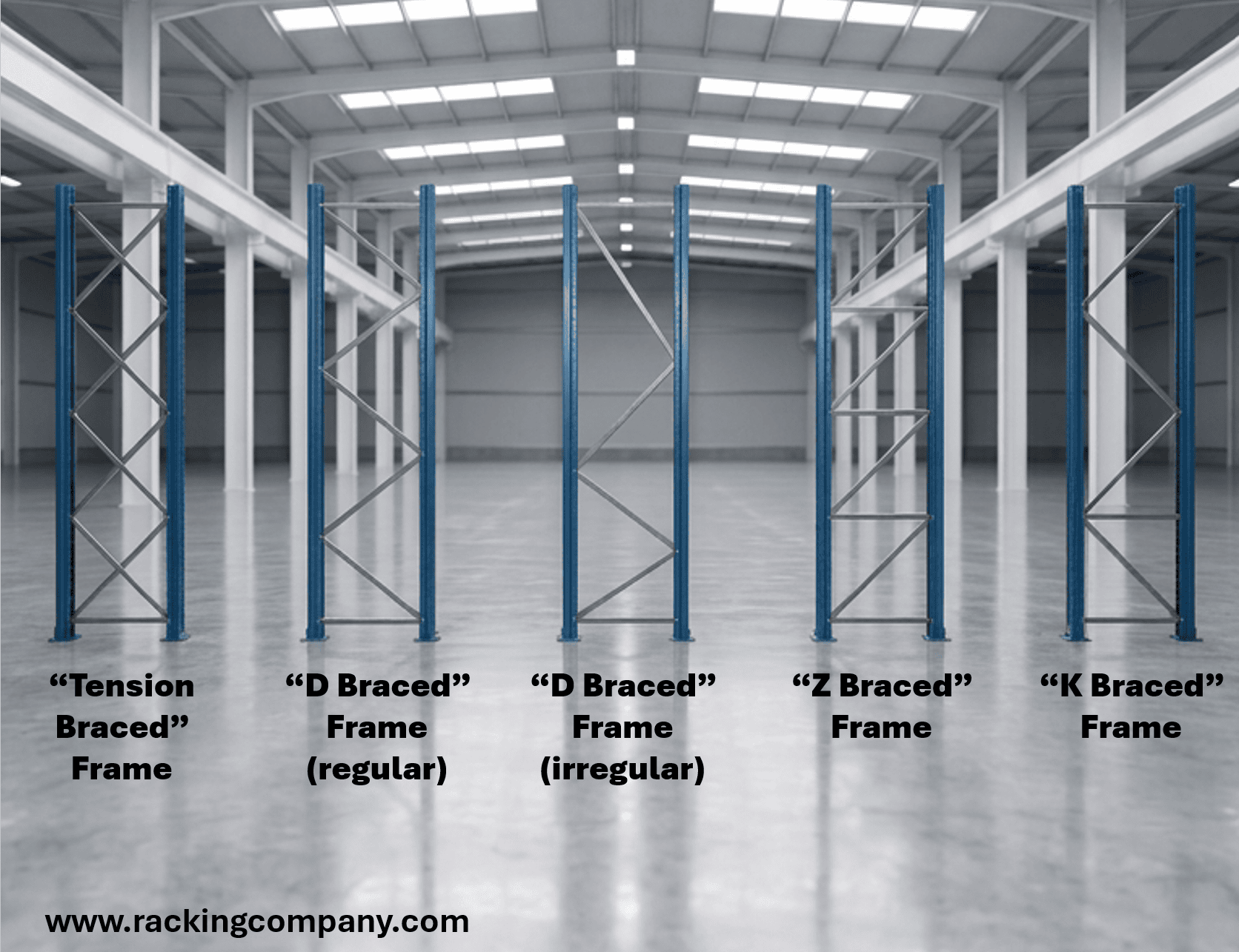
Tension Braced Frame
A tension braced frame uses diagonal members arranged in repeating crossed patterns. This type of bracing helps resist forces by placing members primarily in tension. It is commonly used where additional lateral stability is needed.
“D” Braced Frame — Regular
A regular "D" braced frame uses diagonal members arranged in a consistent repeating pattern along the upright frame. This design provides reliable stability while using a clean and efficient bracing layout.
“D” Braced Frame — Irregular
An irregular "D" braced frame uses a similar diagonal bracing concept but with a non-uniform pattern. This type of frame may be used when specific structural, manufacturing, or load requirements call for a customized bracing layout.
“Z” Braced Frame
A "Z" braced frame uses diagonal members arranged in a pattern that resembles the letter Z. This configuration helps transfer forces across the frame and provides structural stability between the upright columns.
“K” Braced Frame
A "K" braced frame uses diagonal members that connect in a pattern similar to the letter K. This design can provide strong support while allowing forces to be distributed through multiple bracing points.
How Bracing Type Affects Rack Performance?
The bracing pattern used in an upright frame can influence rack stability, load behavior, and long-term durability. While the visible bracing pattern is important, the full structural performance depends on multiple factors, including steel profile, frame depth, upright thickness, beam loads, anchoring, and installation quality.
Why Choose RACO for Pallet Racking Systems?
RACO provides pallet racking systems and warehouse storage solutions designed for strength, safety, and operational efficiency. Our team helps customers select the right rack structures, upright frames, bracing configurations, and accessories based on warehouse requirements and load needs.
Whether the project requires selective pallet racking, double deep systems, drive-in racking, pallet flow, or warehouse safety accessories, RACO helps create storage systems built for long-term performance.
Need help selecting the right pallet racking system or evaluating an existing rack structure?
Contact RACO to discuss your warehouse requirements and get a storage solution designed for safety, capacity, and efficiency.